
Dracula: A Love Tale (2025) - Alive and Loving it!
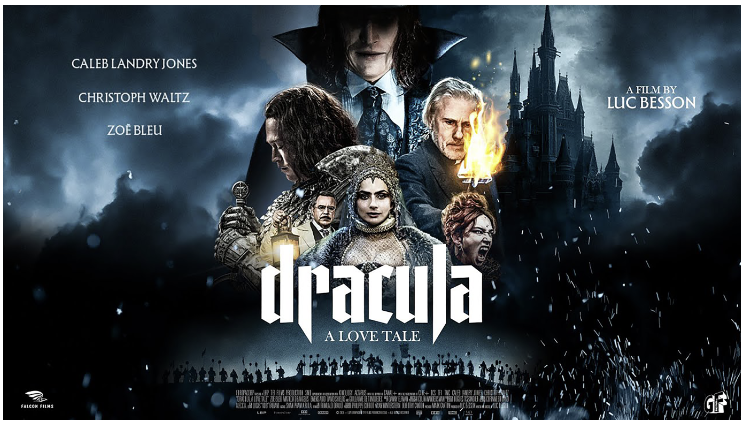
Atypical Film Review by Angela
This one flew under the radar for me until one night, I’m down a YouTube rabbit hole when I saw a trailer with
the description including ‘a French film.’ It is difficult to find the time and energy to read a two-hour flick, so I
dismissed it. Then another screenshot appeared featuring Enya’s “Caribbean Blue,” so I watched it. I mistakenly
assumed Dracula: A Love Tale was a foreign film rather than an English-language film set in France. Thanks to
the aforementioned fan video, I rushed to correct my misunderstanding by watching this film.
Maybe because a small part of my heart wasn't necrotic, I was able to lose myself in this story and ended up
loving this French gothic-romantic fantasy immensely. After several rewatches, I am hopelessly hooked,
obsessed, and in a chokehold!
Fair warning: the title does not lie; this is a love tale, a romanticized version of Dracula that centers on love,
longing, and grief. Director and screenwriter Luc Busson, a French filmmaker who has brought us films such as The Fifth Element,
Leon (The Professional), and Lucy, brings to life the latest reimagining of Dracula. This mostly new version is a
gothic romantic fantasy set against a French landscape, with amazing costumes spanning from 15th-century
medieval Eastern Europe to 19th-century Victorian Paris.
This film takes a page from Coppola’s version by including the reincarnation of Elisabeta (not in the book)
while making new adjustments, such as how Vlad transforms into a vampire, setting in Paris instead of London,
and telling the story from Dracula’s viewpoint rather than Harker’s. The unbearable grief, truest love, and
heartbreak were depicted far better than its predecessor making this a stand-out version.
I commend the editing and cinematography, especially when using flashbacks and crossovers from past to
present. There was a softness to the filming with appropriate lighting for every scene, without being too dark.
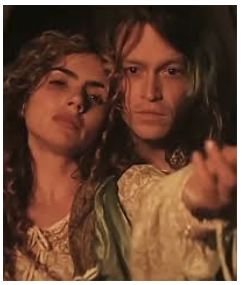
From the opening notes of a music box, I was mesmerized by the Prince Vlad of Wallachia and Princess
Elisabeta (Caleb Landry Jones and Zoë Bleu Sidel). Their love story is in tune with the delicate melody Danny
Elfman composed. We are lost in a montage of shared moments seeing how there is nothing better than finding
love with someone you can not only rule the country with, but also be goofy and vulnerable with.
The Prince is summoned to lead his men against the Ottomans while the Princess is escorted to a safe haven.
Unfortunately, there was an ambush and the Prince hurries to find her. Vlad arrives in time to see Elisabeta
bleeding before dying in his arms. The profound loss of his wife and being robbed of saying good-bye to her
leads Vlad to inextinguishable grief and murderous rage. In return, God’s wrath incurs in the form of an
immortal curse. Jump to 1889, where Van Helsing (Christoph Waltz) visiting an asylum to assess a peculiar patient of Dr.
Dumont’s. They discover she is a vampire, but not first generation. She only offers that her master is a prince in
search of a princess.
We return to Romania, where a young, lanky solicitor (UK speak for lawyer), Jonathan Harker (Ewens Abid), is
dropped off in proximity to Count Dracula’s castle to review the Count’s real-estate portfolio and negotiate a
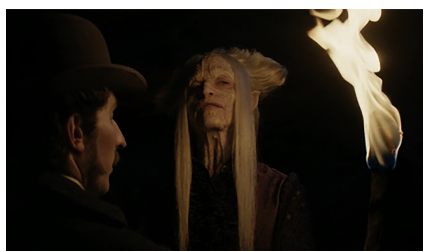
new transaction based in Paris. The coachman gives the newcomer a torch and a crucifix, wishing him the best
of luck on his remaining journey on foot. Despite the surrounding wolves, Harker makes it to the entrance
unscathed and enters a foyer where candles suddenly light and a 400-year-old man appears out of nowhere.
With dinner complete, Harker asks to know the Count’s story. Bewildered and intrigued, he indulges the
request. After all, this version is a love story. Some may not like this narrative form of exposition, but it did not
deter me from the film, and I preferred hearing it from Dracula’s viewpoint because WTF cares about some
lame solicitor’s viewpoint when coming to a strange, foreboding castle whose occupant is a wealthy walking
corpse with a perfectly styled and shiny bouffant?
The Count speaks softly of losing his wife; she was perfect and irreplaceable, meant everything to him, and he
profoundly misses her. He believed in the possibility of her return through reincarnation because the princess
was a pure soul. Although he tirelessly searched for her, having visited every continent and crossed every sea,
he is still only one man. As an occupation, he embarked on a venture to develop a highly concentrated perfume
of pheromones to drug women in order to find his reincarnated true love. The costumes and interior shots were
an effective way to show the passage of time through the Tudor, Russian, Italian, and French courts.
Eventually, Vlad reaches a breaking point before he retreats to his castle, hopeless to find her, biding all the
time in the world with melancholy and defeat. Harker mentions becoming recently engaged to a woman who
would certainly die of grief without him. Her picture lies within the locket around his neck, which the Count
removes to find she is the spitting image of Elisabeta! With his purpose restored, he prepares for a journey to
Paris.
Mina Murray, the fiancé and copy of the princess, meets Van Helsing when she wishes to visit her friend Maria.
Some information is divulged in the conversation, but only hints like her feeling out of place and time. Soon
after, the two friends are reunited and enjoy a whirlwind of festivities at the 1889 Paris Exposition to celebrate
the 100th anniversary of the beginning of the French Revolution.
They arrive at the Hotel de Louvre, where Maria introduces Mina to her friend, Count Dracul. Naturally, he is
overcome with emotion, barely containing his anticipation at seeing her again, unable to readily find the words.
With the festivities behind them, an opportunity comes for the Count and Mina are to converse privately in a
manner that has her conjuring memories that do not seem to belong to her. He encourages her to keep searching.
Van Helsing is certain that the Count is in Paris and that Mina is in trouble. It’s a race against time for Mina to
either accept her former life, including the Count’s role in it. Will they find each other again or be parted for
another four centuries?
THE CAST:
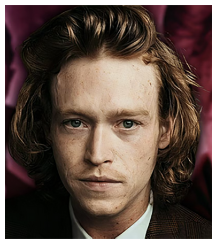
Caleb Landry Jones (Get Out, X-Men: First Class) plays Dracula, and for a native Texan, this man pulled off
an impeccable Romanian accent. His unconventional looks enable him to transform further into the role, like a
chameleon, from formidable warrior to gentle lover. Like Cillian Murphy, the talent and emotional spectrum is
what makes these actors all the more attractive and likable. Caleb did an amazing job embodying this signature
character and, honestly, raised the bar several notches. Even through the prosthetics and make-up, his eyes and
facial expressions are magnificent. Prosthetic makeup was used to make Caleb appear as a 400-year-old
Dracula, and the process required six to seven hours of preparation for his head, torso, and aged hands.
Like Jacob Eldori in Frankenstein, Jones’ ability to say so much without dialogue is simply breathtaking and
moving. He is an exceptional actor with immense talent, and I was sorry I did not recognize him by face or
name. Although he has been critically acclaimed and awarded for independent film roles outside the States, he
has yet to make a mark on a larger scale, which he rightfully deserves.
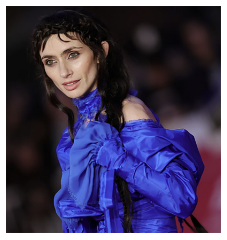
Zoë Bleu Sidel (model, socialite, fashion stylist, and daughter of Rosanna Arquette) plays Elisabeta and Mina
Murray. While she has performed a few smaller roles, this is her first leading role in a feature film. Although
beautiful and compatible with Jones' on-screen chemistry, her character, Elisabeta, relied more on sex appeal
than acting ability, while Mina seemed too reserved and monotonous throughout. While the former has a
discernible accent, the latter sounds more like an American in Paris, despite being from Northern France. She is
literally Emily in Paris (even resembles that character), and, well, that’s not a compliment.
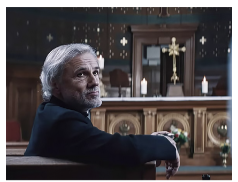
Christoph Waltz (Frankenstein, Spectre, Inglourious Basterds) plays Van Helsing, making him the latest to
star in the ultimate monster duo in the latest adaptations of Frankenstein and Dracula! His mission is to save
the souls damned by Dracula’s curse, starting with the man himself. He is a more empathetic version of
Helsing, treading with care and respect, while understanding his purpose on behalf of humankind in the name of
God. Similar to Dracula, Van Helsing is a bit of a loner, too, as he is the one sent by the Vatican to discern
between science and religion where others fail to investigate, consider, or even comprehend beyond normal
human comprehension otherworldly, unexplainable events. Although not fully accepted by either side, he
commits to this specific purpose on behalf of God. He is humble, morally sound, and provides some light,
humorous moments when most would react hysterically.
This beautiful soundtrack, designed by the one and only Danny Elfman (The Simpsons, Beetlejuice), provides a
fine balance of gentle yet sweeping romance from orchestral strings and the delicate melody of the music box,
with deep, resonant booms to signify tragic drama. Elfman’s exquisite craftsmanship also includes eerie choral
overlays, heartbreaking melancholy melodies, and foreboding rhythms, beautifully showcasing the depth of
grief, the sign of hope, and the beating of a dead man’s heart.
Notable tracks on the album include Music Box, A Bloody Meal, “The Dance,” “It’s Her,” “Last Combat,”
and Eternal Love. This latest adaptation has received mixed reviews from critics and audiences, and has only recouped $42
million worldwide on a $52 million budget.
Regardless, I am obsessed with this version, guilt-free!
Rating: 3.5/4
**Join us on Patreon to gain access to my in-depth reviews with spoilers and recommendations – including this
title!
**Atypical Reviews of Goodbye June, “Wuthering Heights”, The Bride! and Bram Stoker’s Dracula available.
**Be sure to check out my written review of Frankenstein (2025) as well as our two-part podcast dedicated to
the film.
________________________________________________________________________________
Francis Ford Coppola’s Bram Stoker’s Dracula (1992)
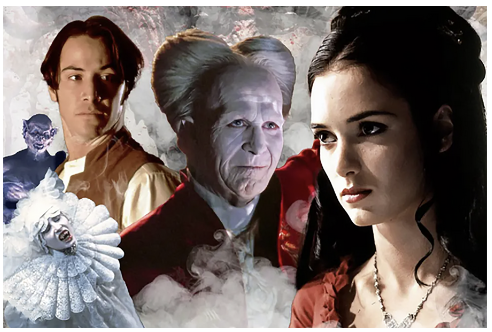
Atypical Review by Angela D. Norris
I know I am in the minority on this film, so to borrow a phrase from Amber on our podcasts that puts my
opinion succinctly: “There is not one scene in this movie that did not piss me off!”
I remember not being able to get into this when it first came out – even as a teeny-bopper – and nothing has
changed in the time since.
Francis Ford Coppola’s Bram Stoker’s Dracula is a dismal, LSD-induced interpretation of this story that I could
barely sit through. The book is a hard read and this is an even harder watch. I absolutely detest this version and
most of the casting (even to the point where Gary Oldman and Anthony Hopkins – the royal Sirs- do not lessen
the ridiculousness of these performances). Sue me!
This overrated film focused more on effects, dissolves, and countless bare breasts than it did on romance, grief,
or connection. Numerous unforgivable sins exist in the movie that entertainingly explained in certain YouTube
videos. At best, this was a C-list production.
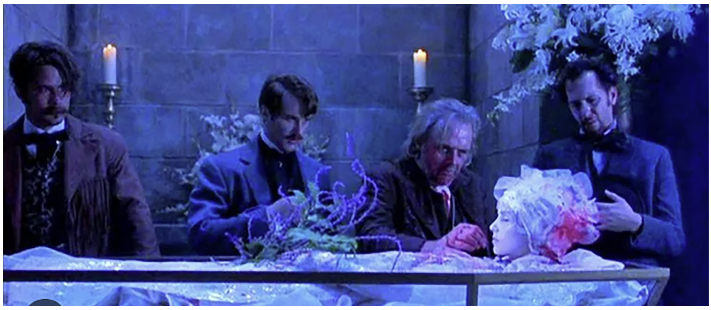
Although it was a delight to see Billy Campbell, Cary Elwes, and Robert E. Grant, who were the only parts in
this to take seriously. The only thing I can fully praise about this film is the soundtrack’s love theme by Annie
Lennox, “Love Song for a Vampire.” Beyond the 1980s, Winona Ryder has no business acting in period pieces, as seen in Exhibit A with this film
and Exhibit B with Martin Scorsese’s The Age of Innocence (1993).
I love Keanu as an actor and person, who should be protected at all costs, but goodt lordt I could not with this!
I would rather be tied to a chair and forced to watch the entire Twilight franchise than be subjected to watching
this again! Kenneth Branagh’s adaptation of Mary Shelley’s Frankenstein was far superior and tolerable than this legit
abomination.
Rating: 0.5/4 – That’s for Annie’s song.
**Available now - Atypical Reviews of Goodbye June, “Wuthering Heights”, and The Bride!
**Dracula: A Love Tale (2025) coming soon!
**Join us on Patreon to gain access to my in-depth reviews with spoilers and recommendations.
Seriously, who wore it better?
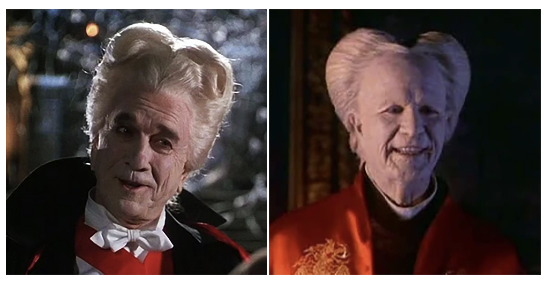
RECOMMENDATIONS:
Dracula: A Love Tale (2025) – Check out my latest review of this latest adaptation of which I am obsessed! Of
course, if you want horror, blood, lust, and all things grotesque – this is NOT the version for you.
Dracula (1931) – featuring the original Bela Lugosi, who is to Dracula what Boris Karloff was to Frankenstein.
This is the first authorized sound film adaptation based on the 1924 play (that starred Bela Lugosi on
Broadway), which was then based on Bram Stoker’s 1897 novel.
Dracula: Dead and Loving it! (1995) – a ludicrous spoof co-written by Mel Brooks, starring the slapstick film
king, Leslie Nielsen.
Dracula (2013 series) – It only lasted one season, but damn, Jonathan Rhys Meyers made a hot Dracula at the
turn of the 20th century!
Guillermo Del Toro’s Frankenstein (2025) – Since we’re talking monsters in modern times, definitely check
this one out!
Destination Wedding (2018) – starring Winona Ryder and Keanu Reeves as opposite strangers who meet en
route to a mutual friend’s wedding. Bitterness, sarcasm, and heavy emotional baggage make their interactions
entertaining when it comes to the notion of love and relationships. Not a rom-com, but they suit this far better
together than FFC’s Dracula.
Much Ado About Nothing (1993) – an excellent adaptation including Keanu Reeves as Don John, the evil half-
brother of the Prince. His accent is a notch more believable even in Shakespearean, and he definitely cared
about his performance in this role. Not bad for a high school dude named Ted.
________________________________________________________________________________
Goodbye June
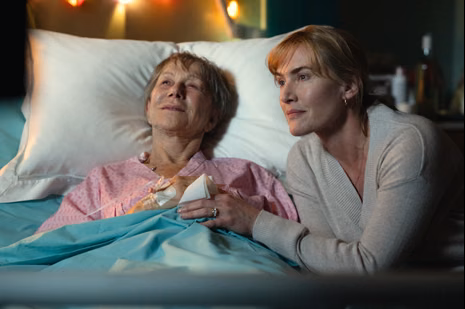
Atypical Review by Angela D. Norris
“Goodbye June” is the directorial debut of Oscar-winner Kate Winslet, who also stars in
it alongside a fabulous cast that includes Helen Mirren, Timothy Spall, and Toni Collette. While
the story may be a formulaic piece that overlaps the impending death of a parent with Christmas,
the tone is not a melodramatic, sugar-laced one. This film does not undermine cancer or death as
a sappy, superficial misfortune, but as an opportunity to mend family grievances with forgiveness and grace.
This is not a dysfunctional family (a term that is often used to describe chaos, conflict,
and hardship within a family dynamic), but a regular one with varying personalities, life
experiences, and choices, that does not always get along with a smile every minute of every day.
If they did, THAT would be dysfunctional! If ever, Helen Mirren has rarely played a weak, defeated character,and she certainly does
not submit to being one just because this character is dying of cancer. As June, she reminds us in
every scene that even though cancer will take her, she is departing this world on her own terms.
On the other hand, her husband Bernie (Timothy Spall) is in denial to the downward turn
of his wife’s health. In a more coherent moment, he nonchalantly confesses to his son, Connor,
how he would have traveled more had it not been for his injured foot or raising kids. Although he
repeats, “You were all worth it,” doubt and regret linger in the silence that follows.
Connor (Johnny Flynn) is the only son and youngest sibling of four, a vulnerable
sensitive soul with anxiety severe enough to chew his thumbs raw. He tries to recollect the last
trip he took as the context implies he has been looking after his parents, particularly June, for the
last several years while living with them.
The first sister to be notified is Julie (Kate Winslet), the second oldest, who is a married
working mother of three, the youngest having an intellectual disability. It is clear she is an expert
at multitasking with a very busy schedule while keeping calm and taking care of everything.
Next, the youngest sister Molly (Andrea Riseborough) takes her brother’s call while
fluttering around her four children and being frustrated with her working husband’s inability to
follow a grocery list. She is overwhelmed, abrasive, bitter, and extremely passive-aggressive,
especially towards Julie.
Julie takes the task of dealing with their eldest sibling, Helen (Toni Collette), who panics
easily with a hundred scattered thoughts to follow. She is a cartoon version of a natural healer
and guru – all about wearing bright colors in patterns, breathing exercises, expelling negative
energy with crystals and burning sage…lots of sage. Due to being out of town, she has to catch a
flight home.
The doctors meet with Bernie and present children to explain June’s prognosis is she will
be lucky to make it to Christmas, which is only two weeks away. One doctor drones on as he
annoyingly clicks his pen to the point where I shouted at the TV simultaneously with Molly
telling him off! Each of the family member’s response to the news varies culminating to sensory
overload for everyone – Molly explodes, Connor breakdowns, Bernie mumbles, and Julie
withholds.
June decides she is remaining in the hospital where she feels safe and wants to
discontinue to the use of certain medications, which means, as power-of-attorney, Julie must sign
some forms. Their mother bestowing her wedding ring to the sister she despises while refusing to
be cared for at her home only increases Molly’s resentment. She retaliates by creating a Rota that
places her and Julie on opposite visiting schedules.
June’s real caretaker is a special man called Angel, as his native name translates to such.
While it may be a bit on the nose, there is no better description of this nurse, beautifully played
by Fisayo Akinade. He is a genuine, tender, unbiased person who provides exceptional care to
June while carefully orbiting her family. This is his area of expertise: observing and guiding
family members through the process with grace, truth, and love.
ONE-ON-ONE (Connor): There is a sweet moment when June asks Connor to read to
her. He admits to not being a good reader, but she tells him to take the opportunity to try. Shyly
he reads, “If There Are Any Heavens” by E.E. Cummings as she listens intently with pride and
adoration.
ONE-ON-ONE (Julie): Julie arrives with a special take-out dinner when June abruptly
states that she’s not going to see Helen’s baby. Julie nods then opens the curtains to surprise June
with a scene of snow falling outside the window. June wonders aloud if she will come back as
snow so she can visit them at Christmas time then wonders if Julie minds her dying. Relieved
that she doesn’t, June asks for mascara and lipstick to be applied so she looks good when she
dies.
When June finds Molly’s Rota, she concocts a scheme with Angel to get both daughters
together under the pretense that she is dying. When they arrive breathless and scared, June
pummels head-on about their treatment of each other, referring to them as “little shits.” She
directs them to hold a notebook in place so she can write a letter to her unborn grandchild with
the promise that their aunties will be there for them. “I love them both so much, but I love them
twice as much when they love each other.”
This coup does the trick as the long-at-odds sisters utilize an empty corridor to clear the
air. Molly begins with admitting how much she idolized Julie growing-up, wanted to be like her
in every way. Then Julie left home and rarely returned to visit which made Molly feel
abandoned. She resents Julie’s success while she struggles to scrape by so disregards it out of
shame for her shortcomings.
Julie opens up about juggling too many balls - her family’s living expenses along with
their parent’s mortgage and occasionally Molly’s when she is unable to cover it. There is also
Helen’s therapy to pay for, awaiting Connor’s next crisis, and her work obligations – mostly
alone since her husband works on the other side of the world. She does it all at the cost of
missing out on her kids’ unlike Molly who is a stay-at-home mom. “Mom is dying, and this is
the most time I’ve spent with kids.”
ONE-ON-ONE (Molly): Molly plays a private game of Scrabble with June, who
inquires after Julie. Molly sheepishly smiles and informs they are cooking Christmas lunch
together, delighting June.
Connor’s breaking point comes when their dad accidently breaks June’s favorite holiday
vase. All the pent-up anger he has been withholding unleashes on Bernie for all his faults, even
asking if he even loves June anymore. Without an answer, his dad heads to the pub. There he
chooses to express himself by singing karaoke, dedicating “Georgia On My Mind” to June.
They cannot stop time, but they can change the timeline so Bernie tells Connor that the
family needs to make tomorrow Christmas Day because June will not be here for the real one,
which is a week away. June is lucid enough to watch the grandchildren’s performance of the
Nativity play, but as it comes to an end with “Away in a Manger,” she fades. The reverse rolling
shot of the camera retreating from the light of the family into a long dark corridor was so
beautiful and poignant, that precious bittersweet moment of a good goodbye.
A year later, the family is gathered around the table for Christmas including a place set
for June at one end of the table. In voiceover, she recites the letter to Helen’s baby, as everyone
is bonding, laughing, and opening Christmas crackers. We even see Angel again as he is in a
relationship with Connor, a surprising disclosure since we are kept an arm’s length from his
personal story. Two of June’s grandsons notice it is snowing so they press their faces to the glass
to watch; perhaps unaware that it is June in a different form. “Good memories help you live
forever, just like me.”
The one-on-ones between June and each of her children, Angel, and Bernie are by far my
favorite parts of the movie, along with the ending. Each character comes with baggage and a
personal stage of grief that does not align with others until June’s death. I appreciate that the
story focuses more on the family dynamic and their individual response to their dying matriarch
than the actual dying part. It does not belittle the prognosis or mislead with false hope; it is
simply being present during a once-in-a-lifetime experience: losing your mother. No, the story
does not reinvent the wheel, but there is plenty of content to find something relatable.
Criticism is going around about Kate choosing her son’s script to develop as her
directorial debut, but I find it endearing and support her decision. What a wonderful springboard
into the director’s chair by working alongside your talented son, bringing his script to life. Kate
has a brilliant reputation as an actor and human being, with the earned freedom to choose such a
project deeply connected to her family. This was a gift of love, an ode to a special mother and
grandmother, which does not require validation from critics or awards. Art can be cathartic and
liberating, not just for the audience, but also for the creators and all involved in the project.
Kate’s mother left a deep impression on her grandson, Joe, so much that he dedicated several
years to writing a script loosely based on their experience.
It is obvious that Kate and Joe’s hearts are in this project, which a superb and supportive
cast (most of whom she worked with previously). She’s not the first director to hand select the
talent based on established working relationship – think Spielberg/Hanks, Burton/Depp,
Scorsese/DiCaprio, Nolan/Pick One, et al. To single her out for this is trivial and hypocritical. As
with her acting performances, I do not doubt that she will continue to learn and grow as a
director if she wishes to do so, only become better. She is a true class act.
If you did not burst completely into tears during the movie, just sit through the end credit
song “Good Goodbye” by Gregory Porter because it will bust open whatever reservoir may be
keeping you together.
3 out of 4 stars. Currently streaming on Netflix.
**As a long-time fan of Kate Winslet, the following are my recommendations if you wish to
become more familiar with her work. I highly encourage you to watch her interviews because
she is just a brilliant, funny, well-rounded person worthy to know better.
· Sense & Sensibility (1995)
· Iris (2001)
· Eternal Sunshine of the Spotless Mind (2004)
· The Holiday (2006)
· The Reader (2008 & Oscar Winner for Best Actress)
· Revolutionary Road (2008 & Golden Globe Winner for Best Actress)
· A Little Chaos (2014)
_______________________________________________________________________________________________________________________
The Misleading Exclamation Mark of The Bride! (2026)
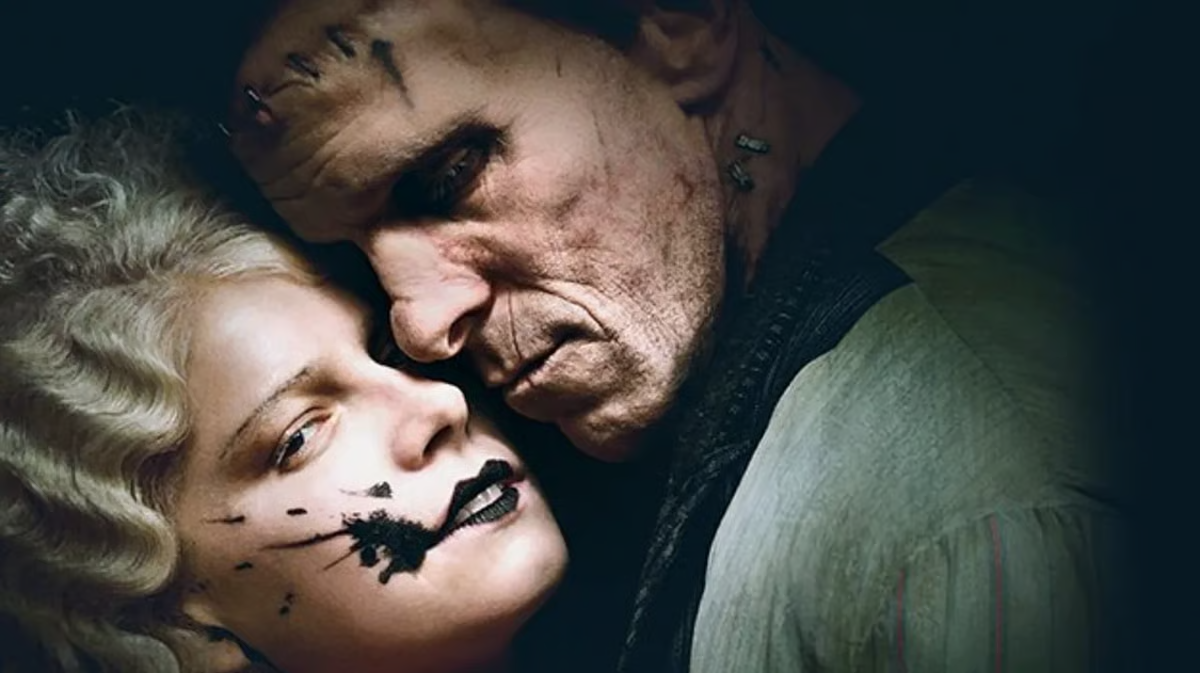
Atypical Review by Angela D. Norris
The more I process this film, the more grievances I list, which only fuels my anger in ways
undoubtedly not intended by writer and director Maggie Gyllenhaal. I had such anticipation for
this film, thinking it would be more like Birds of Prey (And The Fantabulous Emancipation of
One Harley Quinn) rather than The Cat in the Hat meets Bonnie & Clyde.
Gyllenhaal endeavors to explore the mind and behavior of Frankenstein’s bride, but fails
miserably by making the bride a puppet rather than an entity. She is the title and star character,
without the proper star treatment.
Christian Bale is a prime choice for playing dark, tormented characters that teeter on the edge of
insanity before fully succumbing to it. This is not it. Frankenstein (he takes the creator’s name) is
a boring, sensitive loner obsessed with musicals who has finally over being single after 100
years.
Enter Dr. Cornelia Euphronious (Annette Bening), known to the world as Dr. C Euphronious
because ‘Gasp! A lady scientist!’ As a groundbreaking scientist with studies on reanimation,
Frank – as she calls him – seeks her assistance in reanimating a corpse so he can have a
companion.
While Frank does not have any set criteria for his potential bride, you would think some research
would go into this venture. Forget scouring the newspapers or death records for the ideal mate
like a modern dating app, they just dig up a random pile without a gravestone.
His new companion is a bit tricky, seemingly possessed, switching accents, and relearning how
to use her body. Frank is in awe and spares no time in telling her she can share his bed. His
keenness is pure cringe, and suddenly it makes this a transaction with an obligation to be
physical.
Calm down, Frank. The whole city knows you want intercourse.
He and his new lady friend go on their way, attracting attention and trouble, so much so they
must go on the run. Both sides of the law are looking for them – mobsters and cops – while they
keep busy touring the country and attending the cinema.
Frank’s protection is amiable, but that does not make them soul mates. As they get to know one
another, for what little there is, she wants to know her name. Rather than tell her the truth, Frank
gas lights her about their lives. Rather than proving him otherwise, she believes him.
We get a dance number resembling an ode to Thriller that brings absolutely nothing to the story
but distraction.
In Kenneth Branagh’s Mary Shelley’s Frankenstein, Elizabeth resented her reanimation, for she
was now a monster with a scarred body that was not hers, with memory loss, confusion, and
inability to speak and move properly. She hated it so much that rather than choose either
Frankenstein or the Monster, she set herself on fire before jumping off a balcony!
I wanted to see THAT kind of rage, spirit, and conviction!
Florence and the Machine’s “Everybody Scream” provided the soundtrack to the film’s trailer,
which pumped me up for nothing. Stick around for the end credit song and you will understand
what I mean.
This film could have been so much more to the name and the hype; the courage of a woman to
rise above the societal ceiling built by men, to speak up and be loud, to reclaim autonomy, to
expect dignity, and to reject anything that contradicts a woman’s independence, worth, and
safety.
Although we get some original and exhilarating moments, the story is all over the place without
much cohesion. This film includes odes to Mary Shelley (the author), the various movie
adaptations of Frankenstein, musicals in cinema (Fred Astaire and Ginger Rogers), mobsters and
crooked cops, and the struggles of being a woman in the 1930s (or any decade for that matter).
Despite Buckley’s incredible ability and performance with juggling multiple characters
–sometimes simultaneously and sporadically – the story, the characters, and several subplots
prevent The Bride from truly forming. Not only is she incongruous to the world into which she is
reborn for a second life, but she also settles for Frank. Yeah, I said settled.
Even if Jake Gyllenhaal and Christian Bale swapped roles, I would still be looking for Jacob
Elordi’s creature. Frank has some merit, but there is more fizzle in Ida’s hair than in the
chemistry between the two outlaws. This relationship begins with deception and selfish motives
on top of her having zero say in her rebirth, all for the sake of curing a monster’s loneliness.
It would have been great to see a version of this film where it truly was about The Bride,
reclamation of self, and emancipation from expectations…To seek justice for crimes against her
and to set a true example for others. There is no justice or revenge here. There is just random
fuckery.
This is not a love story, and The Bride does not need Frankenstein. She was his only hope, but he
was not her only option. “Wuthering Heights” was more of a love story, and the new adaptation
may be a wild, sultry vision of Emerald Fennel, but at least it makes sense and knows what it is.
For all her ambition and ideas, Gyllenhaal could not pick a lane. Her film is one massive pile-up
from which you cannot look away while also trying to focus on one thing amongst the carnage.
Would I recommend this film? I prefer not to.
Rating: 1.5/4
_______________________________________________________________________________________________________________________
The Wooing of “Wuthering Heights” (2026)
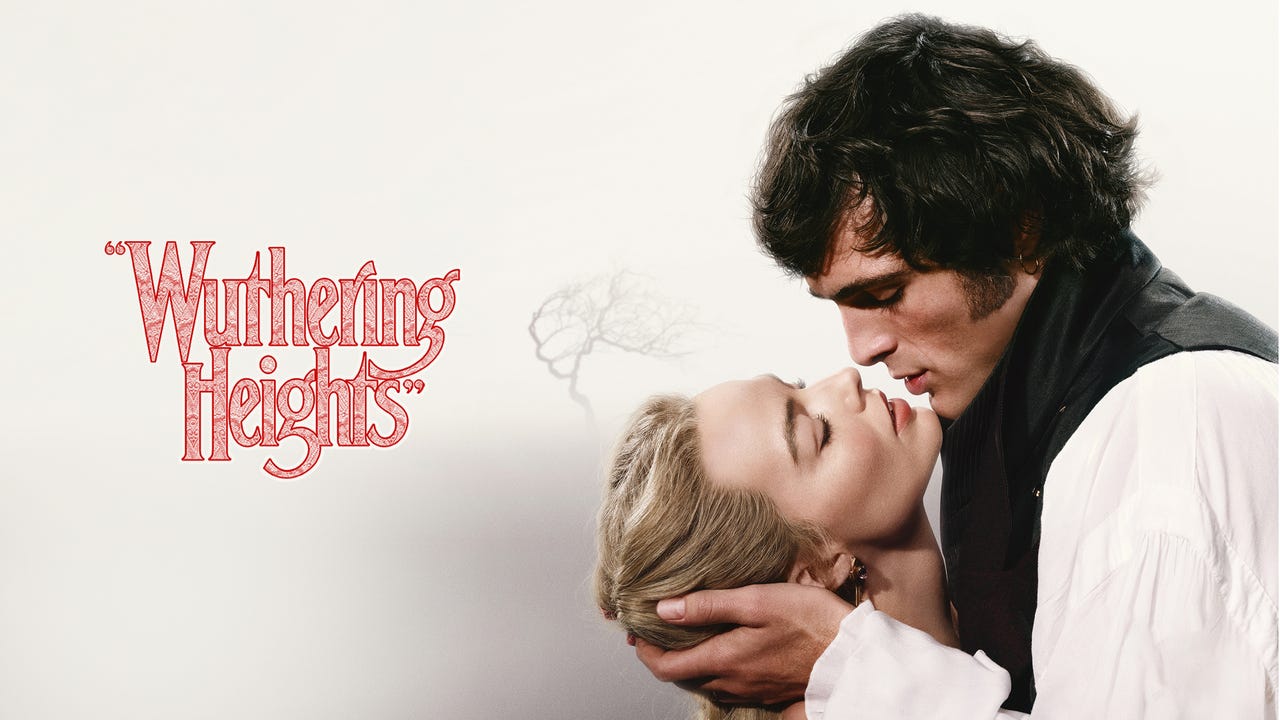
Atypical Review by Angela D. Norris
Just remember how, during Valentine’s Day weekend in 2015, 2017, and 2018, many women
flocked to the film releases of the Fifty Shades series, based on the best-selling novels fan fiction
inspired by the Twilight series. The second I heard a new adaptation of Wuthering Heights was
coming with Jacob Elordi as Heathcliff, my wings were flapping in anticipation.
Based on Emily Brontë’s sole novel (under a male pseudonym because ‘gasp! a female writer!’),
it is a gothic, Victorian story of passion and hate, an obsessive and destructive love believed by
both leads to be on a supernatural level, above the limitations of society and class. Yet those will
prevent and persuade one destructive choice after another, sabotaging self and those nearest.
As indicated in the trailer, this is not a challenge of converting a complex book into a two-hour
film, but the inspiration with a sultry spin to the toxic love story that never stood a chance,
although it has survived in literature for nearly 180 years.
Emerald Fennel, who wrote and directed this twisted fantasy, erased or thoroughly changed
many of the novel's characters and their hands in molding the leads Catherine, into a crooked
basket case of void, and Heathcliff, a dangerous, vengeful villain. Like the former’s fancy
dresses and corsets, the layers have been peeled away to reveal the bare bones of a formidable
and unbreakable bond between these two.
Stripped down to the chaotic, manic obsession that is the crux of Catherine and Heathcliff’s
relationship, Emerald’s hyper-focused viewpoint will have you reaching for a cool glass of
water. Yet, your thirst will be as unquenched as the love is unrequited.
Known for her iconic roles as Harley Quinn and Barbie, Margot Robbie portrays Catherine
Earnshaw, the spoiled daughter who treats Heathcliff like a brother, then equal, then something
far dearer that she never expresses in words to him or fully admits to herself.
The main thing I found distracting about Margot was her blonde hair (not age as some
complained) because all I could see was Barbie. Despite her talent in bringing Catherine into a
different light, darker hair would have not only suited the character better, but also provided that
separation from her usual roles.
On the heels of his Oscar-nominated performance in Frankenstein (2025), Jacob Elordi lives in
the Victorian era yet again, only this time as Heathcliff, the young orphan found by Catherine’s
father, brought home to be her “pet.” The lack of additional characters and context to the amount
of abuse and neglect he endures on the written page makes this version of him watered down and
two-dimensional.
However, Jacob brings the brood, the cool, and the sex appeal with a glance or smirk. You know
he wants to give in and eat Catherine in just one bite, but he is careful with her, protects and
guards, believing they will always have each other. The chemistry between Jacob and Margot is as dense as Jupiter’s atmosphere, as magnetic as the Moon is to the Earth, as dangerous as the Moors themselves.
Enter the competition: a new, rich neighbor by the name of Edgar - gentle, patient, kind, boring-
ass, missionary position only - Linton. Played by Shazad Latif, he brings a softness not often
associated with men of great fortune, and is more likeable in Emerald’s world.
Allison Oliver delivers a wonderful portrayal of Isabella Linton who has plenty of shortcomings
when it comes to society and prospects, finding solace in her dolls and books. She is a perfect
pawn to be used.
Despite the glitter of Catherine and the brooding of Heathcliff, this is NOT a fun film. It is
heartbreaking, chaotic, destructive, smutty, and out of control.
One aspect of this story is a cautionary tale of betraying one’s own instinct, losing oneself to
another’s power, and being bound to another by codependency. What looks like taking control
where you can often leads to filling a void that remains empty. Should we go against our hearts,
we will tell ourselves lies in order to survive those contradictory choices.
Are you necessarily missing out by skipping her version of Catherine and Heathcliff? No.
“Wuthering Heights” is a decadent dessert that pleases momentarily, but still leaves you craving
something more significant.
Rating 2.5/4
Be sure to check out Charlie XCX’s original soundtrack, a gothic, surreal experience featuring
“Chains of Love” and “Always Everywhere.”
**Stay tuned for Angela’s Atypical Film Review of Maggie Gyllenhaal’s “The Bride!”
**Be sure to check out my written review of Frankenstein (2025) as well as our two-part podcast
dedicated to the film.
____________________________________________________________________________________________________________________________